A. D. Pickett
Silent SpringA. D. Pickett was a Nova Scotia entomologist who helped develop a selective, ecologically informed approach to controlling orchard pests. In Rachel Carson’s account, his work turns the argument for biological control into a working agricultural practice: rather than treating insects as targets for ever-stronger poisons, Pickett and his associates accounted for the living relationships among pests, predators, and parasites—and produced fruit as successfully as growers using intensive chemical applications.
Background and Approach
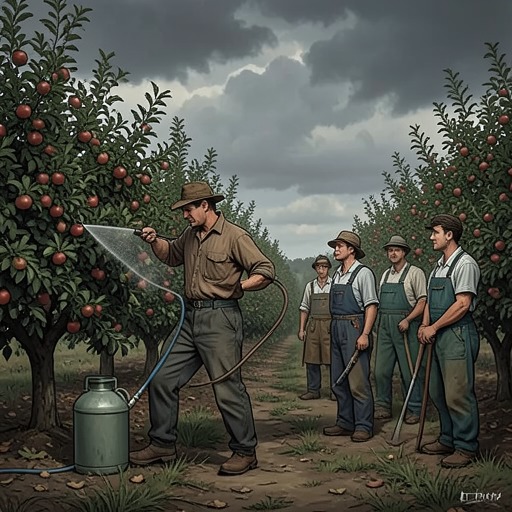
Pickett began his work about thirty-five years before Carson’s account, in the apple orchards of the Annapolis Valley in Nova Scotia, then one of Canada’s most concentrated fruit-growing regions. The prevailing confidence was that insecticides would solve orchard problems. Yet the results of chemical spraying repeatedly included new difficulties: killing useful insects could release other pests, and growers could find themselves moving from one crisis to another rather than achieving lasting control.
Pickett rejected the assumption that the solution was simply a more toxic chemical. Carson cites his insistence that economic entomologists must recognize they are dealing with living things, and that their work must amount to more than insecticide testing or the pursuit of highly destructive chemicals. The point was methodological as well as ethical. An orchard was not a collection of pests to be eliminated one by one; its control depended on understanding the organisms that already checked pest populations.
Designing a Selective Program
Pickett and his associates set out on a different course from entomologists pursuing increasingly toxic treatments. They treated nature as an ally and designed their program to make use of predatory and parasitic species. This meant that timing and choice of chemical mattered: a treatment could be selected or scheduled so that it controlled the target pest while sparing useful organisms.
One example makes the precision of that approach concrete. When a sulphate spray was applied before the apple blossoms turned pink, an important predator was probably spared because it was still in the egg stage. The control decision therefore depended not only on which substance was used but on the predator’s life cycle and the moment of application. Pickett also took particular care to choose chemicals that would do as little harm as possible to insect parasites and predators, resisting the conversion of newer insecticides such as DDT, parathion, and chlordane into routine measures.
Where modern insecticides were used, the amounts could be sharply limited: the program used ounces per 100 gallons rather than the usual one or two pounds per 100 gallons. Carson describes the two materials in question as among the least toxic of the modern insecticides, but Pickett did not regard even that compromise as a final answer. He hoped further research would replace them with safer and more selective materials. The program’s logic was to reduce collateral damage now while continuing to seek less harmful control.
Results and Significance
The program was tested by the practical standard that mattered to orchardists as well as by its ecological design. Nova Scotia growers following Pickett’s modified spray program produced as high a proportion of first-grade fruit as growers relying on intensive chemical applications, and they obtained equally good production. Selectivity, in this account, did not require accepting inferior commercial results.
Carson presents Pickett’s work as a model that had been too little emulated. She finds a comparable approach only in integrated control programs developed by some California entomologists. Its contrast with routine chemical escalation is central: the latter risks trading one pest problem for another, while Pickett’s method works with predation, parasitism, timing, and restrained chemical use as parts of a single system. His example makes biological control more than an aspiration. It demonstrates that agricultural production and the preservation of natural checks on pests can be pursued together.